
Yildirim Okta, Birge  ORCID: https://orcid.org/0000-0001-7872-2239, Okta, G and Opus, M
(2025)
Hill of Tears [Experimental works].
[Data Collection]
ORCID: https://orcid.org/0000-0001-7872-2239, Okta, G and Opus, M
(2025)
Hill of Tears [Experimental works].
[Data Collection]
Abstract
Hill of Tears makes visible the state of “being in-between” through an installation that explores how space can act as a political instrument and how architecture can intertwine with collective memory. Drawing on Judith Butler’s reflections on the political power of public mourning, the installation revolves around two essential questions: “Whose grief counts as public?” and “Can architecture mourn with us?”
It constructs a threshold space where society cannot fully experience, express, or articulate its grief—making the absence of public mourning, the limits of political recognition, and the processes of collective repression spatially perceptible.
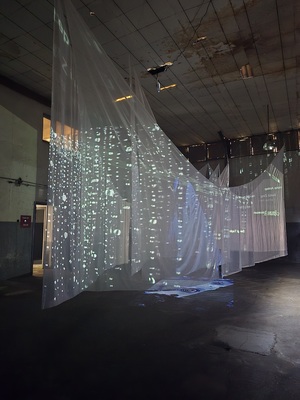
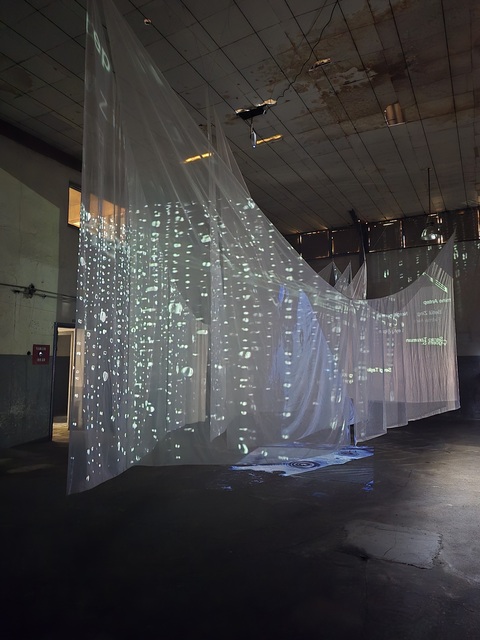
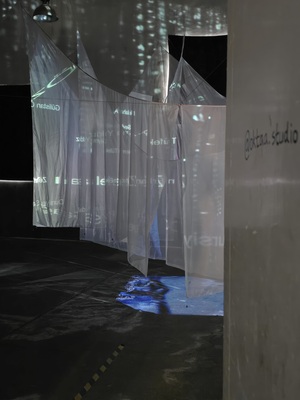
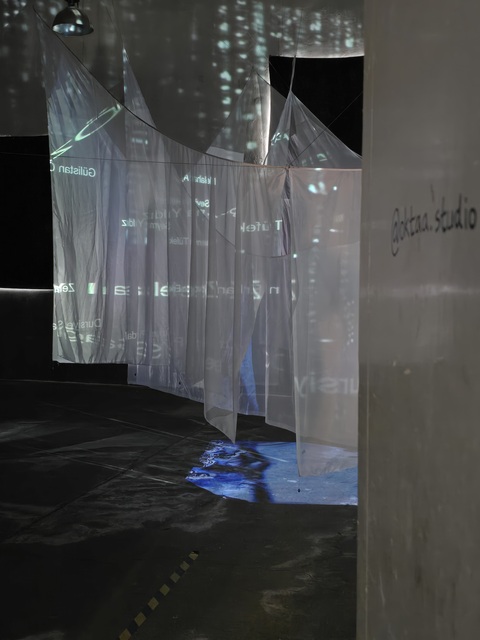
Recalling those condemned to oblivion through the state’s biopolitical framing, Hill of Tears functions as a site of memory that releases the repressed energy of mourning. Public mourning becomes a political act, showing how individual experiences of loss can be transformed into a collective expression. Traumas that are rendered invisible in social memory—such as femicides and child murders—are spatialized in this installation as a collective scene of remembrance. The blurring effect created by the curtains and the refraction of light intensify the sensation of being “in-between.” Within this hazy field, the viewer both sees and loses sight; both witnesses and remains silent.
In a world where grief cannot be voiced or recognized in public space, Hill of Tears exposes the realm where individuals become trapped between mourning and collective memory. Butler’s notion of mourning as resistance here transforms into a stance against enforced forgetting—grief that was suspended at the threshold is finally released.
Inspired by Guy Debord’s concept of the spectacle, the installation seeks to transform the viewer from a passive observer into an active participant in mourning and remembrance. The flickering light and echoing water drops behind the curtains respond to the viewer’s bodily presence, turning the space into a living field where memory, guilt, and witnessing are not only represented but also produced.
Each drop of water behaves like a “tear,” triggered by the viewer’s breath, movement, or silence—blurring the boundaries between individual grief and collective loss. This interaction breaks Debord’s one-way spectacle; the viewer no longer merely observes but weeps, remembers, and bears witness with the space itself.
Located in the Tamirhane Building of the abandoned Battery Factory in Kepez, Antalya, Hill of Tears transforms the site into a performative stage through reflection, sound, and movement. Here, tears merge with light; grief transforms from bodily silence into public resistance.
THE FACTS
According to data from the Ministry of Interior, there were 284 femicides in Turkey in 2022, 309 in 2023, and 275 in the first ten months of 2024.
Regarding child murders, the FISA Child Rights Center’s “Violation of the Right to Life” report states that in 2024, at least 777 children died from preventable causes.
The same report also notes that 56 children were killed as a result of violence or homicide.
| Additional Information: | Depositing user's licence comment: | ||||
|---|---|---|---|---|---|
| Creators: | Yildirim Okta, Birge ORCID: https://orcid.org/0000-0001-7872-2239, Okta, G and Opus, M |
||||
| Uncontrolled Keywords: | Institute of Art & Technology (IAT); 460101 Applications in arts and humanities | ||||
| DOI: | https://doi.org/10.24377/LJMU.d.00000253 | ||||
| Division: | Art & Design | ||||
| Field of Research: | ?? 460101 Applications in arts and humanities ?? | ||||
| Date Deposited: | 22 Dec 2025 11:03 | ||||
| Last Modified: | 22 Dec 2025 11:03 | ||||
| URI: | https://opendata.ljmu.ac.uk/id/eprint/253 | ||||
| Data collection method: | combining spatial experimentation, audiovisual production, and iterative design testing. | ||||
| Resource language: | English | ||||
| Metadata language: | English | ||||
| Collection period: |
|
Download
![[img]](https://opendata.ljmu.ac.uk/style/images/fileicons/text_plain.png)
![[img]](https://opendata.ljmu.ac.uk/id/eprint/253/3/hill%20of%20tears1.jpg)
 Preview |
![[img]](https://opendata.ljmu.ac.uk/id/eprint/253/4/hill%20of%20tears%202.jpg)
 Preview |
![[img]](https://opendata.ljmu.ac.uk/style/images/fileicons/text.png)
![[img]](https://opendata.ljmu.ac.uk/style/images/fileicons/video.png)
Explore Further
Read more research from the creator(s):
Find work funded by this grant:
Actions (Log-in required)
 View Item